Non-Invasive CGM
Diabetes runs deep in my family. My father has been living with diabetes for years, and now, in my late 30s, I find myself classified as pre-diabetic. The reality of hereditary health risks means that monitoring my glucose levels is more than a precaution; it is a daily necessity.
However, current Continuous Glucose Monitors (CGMs) impose a friction on daily life. While effective, they are slightly invasive, relying on a tiny filament inserted into the skin. This creates persistent discomfort, acting as a physical reminder of the condition that you are constantly aware of. Furthermore, the experience is disjointed. Despite wearing the sensor, accessing the data often requires pulling out a phone and unlocking an app. You feel the device on your body, but the information is locked away behind a screen.
The Philosophy of Less
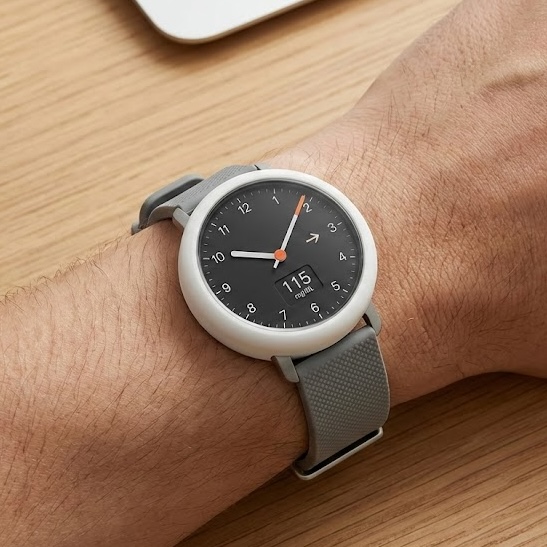
The philosophy behind this interface is radical simplicity and pure utility. It removes the noise of complex graphs, gamification, and digital distractions. The goal is to provide essential health monitoring that integrates seamlessly into life, not a device that demands attention.
- Tactile: A physical object that tells time first, and health second.
- Invisible Tech: No needles. No apps to open. Just a glance.
- Clarity: It answers only two questions: What is my number? and Where is it going?
The Science: Optical Spectroscopy
How do we achieve this without the filament? The technology relies on Near-Infrared Spectroscopy (NIRS).
Glucose molecules in the blood absorb light at specific frequencies, creating unique spectral signatures (particularly around 940nm and 1050nm). By emitting these wavelengths into the tissue and analyzing the scattered light that returns, algorithms can calculate glucose concentration without breaking the skin.
While current invasive CGMs (like Dexcom or Libre) achieve a Mean Absolute Relative Difference (MARD) of roughly 8-9%, non-invasive optical technology has historically hovered around 15% due to signal interference from skin thickness and hydration. However, recent breakthroughs in machine learning are narrowing this gap, pushing accuracy closer to the 10% threshold required for reliable clinical decision-making. This device envisions the tipping point where optical precision matches the reliability of a physical sensor.